In-Depth Ukrainian News, Analysis and Commentary
Ukrainian History, Culture, Arts, Religion, Business, Economics,
Sports, Government, and Politics, in Ukraine and Around the World
1. UKRAINE'S TYMOSHENKO DROPS LEGAL CHALLENGE ON ELECTION
Natalya Zinets and Richard Balmforth, Reuters, Kiev, Ukraine, Sat, Feb 20, 2010
3. SUPREME ADMINISTRATIVE COURT ACCEPTS TYMOSHENKO'S DECISION
4. LOSER IN UKRAINIAN ELECTIONS COULD BE THE LAW
Analysis & Commentary: by John Marone, Columnist, Kyiv
5. YANUKOVICH CANNOT AFFORD AN EXCLUSIVELY PRO-RUSSIAN POLICY
Analysis & Commentary: by Aleksei Malashenko, Carnegie Moscow Center
Kommersant, Moscow, Russia, February 17, 2010
6. UKRAINE'S ELECTIONS: A WATERSHED OR NEW STALEMATE?
Chatham House Programme Paper, London, UK, Thu, 18 Feb 2010
Yezhednevnyy Zhurnal, Moscow, Russia, Fri, February 12, 2010
9. NARROW YANUKOVYCH VICTORY IN UKRAINE ELECTION FOLLOWED BY CONTINUING STRUGGLE
10. PUTIN SHOULD BEWARE OF KIEV POLL AFTERTASTE
11. GORBACHEV HOPES YANUKOVICH TO OVERCOME AMERICAN FACTOR
13. BULGAKOV IS ONCE AGAIN OUR GUIDE TO UKRAINE
15. UKRAINE'S ELECTION: NO CHANGE WE CAN ENTIRELY BELIEVE IN
16. COULD PARTITION SOLVE UKRAINE'S PROBLEMS?
19. DEFENDING DEMOCRACY: TYMOSHENKO TAKES BATTLE TO THE COURTS
INFORM: Newsletter for the international community providing
views and analysis from the Bloc of Yulia Tymoshenko (BYuT)
Kyiv, Ukraine, Monday, Feb 15, 2010, Issue 141
20. THE REVOLUTION IS DEAD. LONG LIVE THE REVOLUTION
Just because the Orange revolutionaries lost in Ukraine, doesn't mean their cause did.
Analysis & Commentary: By David J. Kramer, Foreign Policy, Wash, D.C., Mon, Feb 8, 2
Analysis & Commentary: By Tammy Lynch, The ISCIP Analyst
Analysis & Commentary: By Ivan Poltavets and Ievgenii Rovnyi
Inside Ukraine #5, International Centre for Policy Studies (ICPS)
Kyiv, Ukraine, Thursday, February 18, 2010
Op-Ed, By Steven Pifer, The New York Times, NY, NY, Tue, Feb 9, 2010
Opinion Europe, Analysis & Commentary: By Adrian Karatnycky
The Wall Street Journal, NY, NY, Monday, February 8, 2010
Commentary: By Robert McConnell, Vice President, Armor Designs
By Peter Worthington, Columnist, The Toronto Sun
1. UKRAINE'S TYMOSHENKO DROPS LEGAL CHALLENGE ON ELECTION
KIEV - Ukrainian Prime Minister Yulia Tymoshenko on Saturday dropped her legal case challenging the election of rival Viktor Yanukovich as president, saying the court could not be trusted to reach a fair verdict.
The charismatic 49-year-old premier, who had alleged vote cheating by her opponent in the February 7 runoff and had been pressing for a new round of voting, said she was withdrawing her legal case because the court had refused to study the evidence she had put before it.
With her hair plaited in her trademark peasant braid, she looked tired and tense on Saturday as she announced her climb-down after months of battling with Yanukovich for the leadership of the former Soviet republic of 46 million.
But she refused to concede his victory had been honestly won and a deputy of her BYuT political bloc said it would boycott his swearing-in next Thursday.
"A fraudulent vote took place and the will of the people was fraudulently handled. Sooner or later, an honest prosecutor's office and an honest court will come to the view that Yanukovich was not elected president of Ukraine and that the will of the people was falsified," she said.
Some of the ground had been cut from under Tymoshenko by Western governments which quickly congratulated Yanukovich on his victory and privately urged her to gracefully accept defeat.
Her climb-down defused much of the political tension which has gripped the country and it seemed likely to be welcomed by investors who are anxiously awaiting the return of political stability in Ukraine.
The country, whose economy took a battering in the global downturn with its valuable steel exports losing markets, has been relying on a $16.4 billion bail-out program from the International Monetary Fund.
This has been suspended because of breached promises, but is expected to resume once political stability returns. Tymoshenko is now likely to switch her energies to the political fight against Yanukovich, whose supporters in parliament on Friday took the first steps to force her out as prime minister.
After a bitter campaign of smears and insults, Yanukovich has ruled out any alliance with her and has asked her to quit. She has refused and can be replaced only when the Yanukovich camp has managed to forge a new coalition among the fickle deputies of Ukraine's parliament -- normally a long and tricky task. If he fails to do this, he may be forced to call early parliamentary elections. (Writing by Richard Balmforth; editing by Angus MacSwan)
2. TIMOSHENKO DROPS APPEAL, CEDES VICTORY TO YANUKOVYCH
By Daryna Krasnolutska and Kateryna Choursina, Bloomberg
'CLOSE THE CASE'
Oleksandr Lavrynovych, a deputy parliamentary speaker and a Yanukovych party member told reporters today in the court that "from a judicial point of view this means that there may be an end to the hearing today as Timoshenko left the court building and the code of procedures allows the court to close the case."
DEBT INSURANCE
Ukraine's sovereign debt is the third most expensive to insure after Venezuela and Argentina, according to credit default swap spreads. The country's CDS spread has widened almost four times after the 2004 Orange Revolution, indicating heightened investor perceptions of a default risk, and stood at 978.9 basis points yesterday, compared with 946 before Feb. 5, according to Bloomberg data.
Yanukovych has urged Timoshenko to resign as prime minister and move into opposition, allowing him to form a new coalition in parliament and appoint a Cabinet. Timoshenko has refused.
The resolution was published on Parliament's Web site yesterday and may be voted on in March as the Kiev-based legislature meets next week only for the inauguration of Yanukovych.
FIRST CHALLENGE
The new president's first challenge will be to form a majority in the 450-seat Kiev-based assembly to oust Timoshenko. Yanukovych's Party of Regions would need to secure 226 votes to back the bill. If the vote is successful, Timoshenko's government would remain in power in a caretaker capacity until a new administration is formed.
NOTE: With assistance from Paul Abelsky in Moscow. Editors: Douglas Lytle, Chris Kirkham. To contact the reporter on this story: Daryna Krasnolutska in Kiev at +38-044-490-1252 or dkrasnolutsk@bloomberg.net Kateryna Choursina in Kiev at +38-044-490-1282 or kchoursina@bloomberg.net. To contact the editor responsible for this story: Tasneem Brogger at +44-20-7330-7794 or tbrogger@bloomberg.net Chris Kirkham at +44-20-7673-2464 or ckirkham@bloomberg.net.
========================================================
3. SUPREME ADMINISTRATIVE COURT ACCEPTS TYMOSHENKO'S DECISION
The court rejected Tymoshenko's claim that election rigging was proven during the consideration of the appeal. The court's decision is final and not subject to appeal.
As Ukrainian News earlier reported, Tymoshenko earlier told the court that she was withdrawing her appeal against the results of the presidential elections and left the court building.
Tymoshenko told journalists that the court was biased and expressed the view that the court refused to allow live broadcast of its proceedings because it did not want Ukrainians to see how it refused to admit significant evidence of election rigging.
----------------------------------------------------------------------------------------
[return to index] [Action Ukraine Report (AUR) Monitoring Service]
4. LOSER IN UKRAINIAN ELECTIONS COULD BE THE LAW
Another colorful Ukrainian election has been held, to the indifference of many voters and the relief of many foreign investors and governments.
And while Victor Yanukovych is still trying to uphold his victory against the legal objections being raised by challenger Yulia Tymoshenko, the law itself could be defrauded.
Respected European observers such as the OSCE, the Parliamentary Assembly of the Council of Europe (PACE), the European Parliament and others have endorsed the election as free and fair. World leaders such as Obama and Sarkozy sent their congratulations before the official results were released.
Indeed, compared to the falsification fest of 2004, in which Mr. Yanukovych featured most prominently as the opponent of Ukrainian democracy, the voting on February 7 was truly an achievement.
Tymoshenko may have been the heroine of the 2004 Orange Revolution that forced Yanukovych to eventually concede defeat, but this time she is beginning to look like a sore loser. Nevertheless, the lady in braids, alleging widespread cheating, has vowed to let the courts decide the issue.
The ball has now been passed firmly into the hands of professional politicians.
It's among them where the law gets stretched, mangled, torn, re-sewn, put through a bleaching and then hung out to dry behind a wall of opaque legal terms.
Since its Independence nearly 20 years ago, Ukraine has struggled to make the transition to law-based society. Ironically, however, that transition hit its first reversal during the Orange Revolution, when hundreds of thousands of pro-democracy protesters took to the streets to demand that their vote be counted – honestly.
Orange leader and now lame-duck Ukrainian President Victor Yushchenko, apparently frightened of the opposition that the old guard were putting up to the revolution, agreed to a controversial and hastily drafted set of changes to the country's constitution, which essentially guaranteed the five years of chaos that his presidency has come to be associated with.
For one thing, just like Yushchenko, Yanukovych will inherit a presidency much weakened from the years leading up to the Orange Revolution, when presidents such as Leonid Kuchma hired and fired premiers like secretaries, forged foreign policy like kings and showered their cronies with economic advantage.
With the exception of the Communists, there is in fact very little difference in the platforms of Ukraine's four other factions. Yanukovych's Regions Party is perceived as closer to eastern Ukraine and Russia, while the rest are more or less centre-right and nominally pro-European.
========================================================
5. YANUKOVICH CANNOT AFFORD AN EXCLUSIVELY PRO-RUSSIAN POLICY
Russia had better stop pushing Victor Yanukovich
Aleksei Malashenko, Carnegie Moscow Center
Kommersant, Moscow, Russia, February 17, 2010
What capital should Victor Yanukovich visit first after his inauguration? There might be some who will find it a rhetoric question. Why, Moscow, of
course. After all, it is Russia that has always pinned hopes on Yanukovich, at least publicly. Time to live up to the expectations at long last.
President Dmitry Medvedev invited his Ukrainian vis-a-vis to Russia as though to remind Yanukovich of it. Now that Victor Yuschenko is as good as gone, Ukraine is once again moving into the focus of Moscow's attention. Speaking of official Kiev's future foreign policy, most experts say that the new president
will concentrate on promotion of Ukrainian interests.
Moreover, it will be up to Yanukovich to decide if these interests tally with the interests of Russia - and to what degree if they do. It is this knowledge that makes Moscow fret and that foments the desire to tell the new Ukrainian leader what the correct choice is.
Yanukovich's inauguration is still in the future and so is a new ruling coalition in the Rada, but the other Russian leader is already condemning "leadership of the color movement" for its choice of "political sponsors". Answering Russian Premier Vladimir Putin, Yuschenko warned that "nobody would dare" revoke his decree that made Stepan Bandera Hero of Ukraine.
Yanukovich is thus demanded to make up his mind. And what does Moscow expect him to choose when he needs the parliamentary majority which he will never have without Yuschenko's following in the Rada?
It is necessary to remember that winner of the 2010 presidential race polled under 50%. Or that all of Ukraine (some with curses, others with elation)
regards him as a pro-Russian politician.
In the meantime, recalling this nuance at the earliest opportunity is reckless, to put it mildly. Moscow's attempts to push Yanukovich will only make him wary and compel him to keep proving to the Ukrainians that he is an independent leader of a sovereign state.
It does not take a genius to see that Yanukovich cannot afford an exclusively pro-Russian foreign policy. He is more likely to promote the policy of European integration. Sure, he will be looking over his shoulder at Moscow every now and then but Moscow had better hold its horses.
The more pressure it applies to Yanukovich, the more motivated he will feel to prove his pro-European nature - to the world, to Ukraine, and to himself.
Should Moscow keep squeezing the life out of Kiev in its bearish hug, it will eventually break away and ditch Russia for good.
LINK: www.kommersant.com
========================================================
6. UKRAINE'S ELECTIONS: A WATERSHED OR NEW STALEMATE?
Chatham House Programme Paper, London, UK, Thu, 18 Feb 2010
On 14 February, Ukraine's Central Electoral Commission officially declared Viktor Federovych Yanukovych the country's fourth elected president since Ukraine declared independence on 24 August 1991. It was, in the words of Ukraine's authoritative web-based journal Glavred, 'the most boring election in the history of Ukraine's independence'. That is good news.
But worries now overshadow them. For nineteen years Ukraine has defined itself unequivocally as a European rather than a Eurasian state, and it generally has been accepted that the quality of its independence is inseparable from its ability to distinguish itself from Russia.
The truth of the matter will not be known for some time, and it will not be determined by Yanukovych alone. If, as expected, his victory is confirmed by the courts (who face legal challenges from his rival, Prime Minister Yulia Tymoshenko), he will come to power in an economically ruined country, deeply dependent on Western-dominated financial institutions.
Nevertheless, as President, Yanukovych will wield considerable power, and it is prudent to worry about how he might use it. He will also have the support of a large, embittered and vindicated constituency which, unlike the disillusioned supporters of Tymoshenko, loathed the Orange Revolution too much to feel betrayed by it. For most of his career, Yanukovych has behaved in accordance with the axiom, 'influence is good, control is better'.
THINKING THE WORST
Yanukovych, his inner circle and his constituency are also convinced that a course that sets Ukraine at cross purposes with Russia is dangerous for the country's security and distressing to the majority of its people. However, the risk is not that Yanukovych, any more than Kuchma, will choose to be a 'vassal of Russia'. It is that the steps he takes will inadvertently damage his other professed objectives: closer relations with the EU, cooperation with NATO and the economic success of Ukraine.
[1] Energy. Yanukovych has articulated two firm principles regarding energy. He will renegotiate the Tymoshenko-Putin January 2009 Ukraine-Russia gas supply contract (which, in the opinion of most energy specialists, has brought greater transparency to European energy markets), and he will resurrect the 2002 scheme to transfer ownership of Ukraine's state-owned gas transit system to a three-way consortium. As he told Russia-24, 'I would like us to return to the format of relations we had five years ago'. Yet five years ago, there was no gas consortium, because Kuchma had no intention of going forward with it.
[2] Russia's Black Sea Fleet, whose lease in Crimea, according to the 1997 accords, is due to expire in 2017. That Yanukovych is open to extending the lease is unsurprising, and it is widely rumoured that Tymoshenko expressed the same openness to Prime Minister Putin during the gas negotiations of November 2009. But under today's terms, which render significant aspects of the Fleet's activity—economic, military and intelligence related—unspecified and unregulated?
[3] NATO. Yanukovych's pledge to 'participate actively' in President Medvedev's European security initiative will mean little until the West's core institutions, NATO, the EU and the OSCE agree to do the same. His formula of maintaining cooperation with NATO whilst deferring discussion of membership for the indefinite future means equally little in view of political realities in Europe. But what will 'cooperation' mean in practice?
This catalogue of dread, assiduously presented by Yulia Tymoshenko's campaign team, would fundamentally alter Ukraine's place in Europe. But is it realistic?
THE RATIONALITY OF HOPE
There are four good reasons to hope that it is not realistic:
[2] Divisions in the Party of Regions. Viktor Yanukovych might be an authoritarian figure, but by comparison to the personalised Bloc of Yulia Tymoshenko, the Party of Regions is a pluralistic party. The party's biggest financier and Ukraine's richest man, Rinat Akhmetov, has no wish to see Ukraine put additional barriers between itself and Europe, whether through defiance or incompetence. Like at least half of the party elite, the most probable new foreign minister, Konstyantyn Gryshchenko (now ambassador in Moscow), has never sought integration with Russia, but integration with Europe by means that do not antagonise Russia.
[3] A Transformed Energy Market. Yanukovych's gas consortium initiative is out of kilter with economic and political reality. For one thing, two gas crises and the Russia-Georgia war have changed the climate in Europe. Diversification and marketisation are now seen as imperatives, and the measures proposed by the European Commission have begun to take root.
[4] Relations with the West. The West's influence is now inescapable, however Washington and Brussels plan to make use of it. Ukraine's GDP fell by 14 percent in 2009, inflation is running at an annual rate of over 12 percent, budget revenue plunged by 20 percent, banking deposits by 26 percent, and capital flight rose to $13.6 bn. External debt exceeds $30 bn, and debt servicing requirements stand at $4 bn per annum.
Given all these factors, it would be surprising if Yanukovych's presidency did not enhance what has been the defining feature of Ukraine's political culture: distrust of power. The country that elected him seeks stability, not repression, and if Yanukovych forgets this, he will swiftly discover that the polity is far from powerless. Whether this mixture of ambitions, impulses, pragmatism and constraints leads to responsible government, a new set of stalemates or a muddle remains to be seen. But the West needs to be acting, not just watching, because once again there is everything to play for.
----------------------------------------------------------------------------------------
[return to index] [Action Ukraine Report (AUR) Monitoring Service]
========================================================
7. UKRAINIAN, RUSSIAN SYSTEMS COMPARED IN LIGHT
Yezhednevnyy Zhurnal, Moscow, Russia, Fri, February 12, 2010
We really do not want to argue with Yuliya Latynina herself, but we will have to do so. Otherwise, Yezhednevnyy Zhurnal readers may think that practically a Hitler has come to power in Ukraine, and that the right of the Ukrainian people to choose a president for themselves has been discredited once and for all.
And so, let us proceed in order.
[1] First of all.
Today, there really is a very bold and talented charismatic leader in Ukraine. A left-wing populist who in hers political-economic views is close to Hugo Chavez, and by her ability to mesmerize the popular masses with unpardonable demagoguery - is only slightly beneath Adolph Hitler. This politician is Yuliya Tymoshenko.
Two years ago, when Tymoshenko became Prime Minister of Ukraine for the second time, and a year ago, when she cobbled together her new coalition in parliament, and even half a year ago, one got the impression that the triumphal march of the Ukrainian "Chavez with a braid" toward the presidential office could not be stopped.
If Tymoshenko had won the 2010 elections, the powers of President and Prime Minister of Ukraine would in fact have been concentrated in the same hands. (Her trusted deputy and aide would have become the head of government). And the political regime in Ukraine would soon have been transformed from institutional-democratic to authoritarian-charismatic. Specifically of the Chavez type. Anyone who has even a slight acquaintance with Tymoshenko and her political history cannot have any doubts about this.
Thanks to the choice of the relative majority of the Ukrainian people, there will not be any charismatic authoritarianism for now. Democracy will remain. Among other things, because Ukrainian politics will continue to be polycentric. Both Yanukovych and Tymoshenko will be retained in it, and their competition will inevitably require democratic mechanisms and institutions.
So that, by their choice, the Ukrainian people defended democracy. Glory be to them!
[2] Secondly.
The departing president, Viktor Yushchenko, deserves many reproaches: For exhibiting weakness, for his indecisiveness, and for his inability to be friends and to value friendship. For the fact that he did not ensure economic reforms, he may simply be torn to pieces.
But he also deserves some congratulations. For the fact that he had promised to hold honest and free presidential elections. And he did so. Without trying to latch on to power. He did not appoint himself as successor. He did not shoot up parliament.
He guaranteed real freedom of speech - and today we have it in Ukraine.
He wanted foreign players not to intervene in Ukrainian politics in a major way - and that is what happened. In all of the post-Soviet time, the 2010 elections became the first at which that same Kremlin did not have a clear favorite, and did not influence the result.
Viktor Yushchenko wanted to not allow Yuliya Tymoshenko to assume the office of president, because he saw in her a source of authoritarian threat. And he did not allow her to do so. So that Tymoshenko lost out not so much to Yanukovych, as to Yushchenko. According to my initial estimates, were it not for the departing head of state, Yuliya Vladimirovna would have received 7-8 percent more votes, and would have become president. With all of the aforementioned consequences.
So that we can and must curse Yushchenko, but we should not make him out to be a worthless nothing and a pumpkin-headed oaf.
[3] Thirdly.
I do not know how many poor, not rich and rich people voted for Yanukovych and Tymoshenko, respectively. Maybe sociologists will soon tell us.
However, I know something else for sure: How the very rich acted. The Ukrainian oligarchs.
Almost in their full complement, they came to the Kiev Intercontinental Hotel on the night of 7-8 February, where a fatigued Yanukovych staff was seething with uneasy victory. About half of those who came to pay homage to the winner were sponsors of the Tymoshenko campaign, who had even quite recently placed the stake on her success. But, as the old saying goes, the concept changed - and they hastened to kiss the ring of the newly elected president.
To the outside observer, these richest people appeared belittled and pathetic. But of course, they did not seem pathetic to themselves. After all, they had come to protect their big money. And in order to protect big money, the classical post-Soviet oligarch is ready to opt for any moral-political sacrifices. If he has to dance naked on a table - he will dance.
And it is certainly not democracy, and certainly not the future of Ukraine that worried the oligarchs at that same intercontinental moment.
In just the same way, in 2004 all of the very rich Ukrainians had placed their stake on the programmed victory of Yanukovych. But then, during and especially after Maydan, they ran to bow down to Yushchenko.
And it was certainly not the rich who staged the Maydan. Just as it was not the rich who turned out for demonstrations in Moscow in 1990-91. And it was not the rich who elected Yushchenko in 2004, and Yeltsin in 1989, 1990 and 1991.
However, the rich did elect Vladimir Putin. In 1999. So that he would protect their interests. Against democracy. Which Putin successfully did.
The one whose political choice depends on money will never choose democracy. Because money likes quiet. And quiet in this case is the antonym of freedom.
[4] Fourthly.
Viktor Yanukovych is, of course, a very heavy passenger. His gloomy demeanor and his total inability to speak are quite obvious. And by his tactical-technical characteristics, he is, of course, no democrat. Although the victory which, at his own admission, he had waited 5 years to achieve, he owes entirely to democracy. And only to it.
The irony of Ukrainian history has proven the ultimate correctness of democracy to Yanukovych.
Yanukovych bided his time, waited, went to fully democratic elections, and is now the legitimate head of a free state. Barack Obama, Nicholas Sarcozy and even Mikhail Saakashvili have already congratulated him. Vladimir Putin (fortunately for Yanukovych!), unlike 2004, has not yet done so. (Remember the anecdote: "Putin congratulated Yanukovych for the seventh time on his victory in the elections, and also wished Yasser Arafat a speedy recovery.")
Yanukovych, of course, called Chekhov a Ukrainian poet, and Anna Akhmatova - Anna Akhmetova. But he never beat his close aide Anna German, never called protesters morons, never confused the gene fund with genocide, and never got slapped in the face by Rinata Akhmetova. These are all political-technology fabrications of a competing firm. Perhaps, partly even clever. But it is not right to use them as facts and material for an honest analysis of present-day Ukrainian politics.
[5] Fifth.
Let us recall once again: In our Russia, the one who is in fact categorically opposed to democracy has the honor of being called a democrat.
We pretend that we are dreaming of freedom. And that we hate usurpers.
But when we are shown how real freedom in fact operates, we turn up our noses. Because freedom does not always - oh, not always - smell of perfume and cognac. Because it often reeks of coastal deadwood, hobo pants and yesterday's garlic. And then, right away, we do not need such freedom. It will probably lead us to the wrong place.
Better to continue to curse the accursed Putin and his Petersburg siloviki (security services officials). What the heck, that is so convenient.
----------------------------------------------------------------------------------------
========================================================
Send in a letter-to-the-editor today. Let us hear from you.
========================================================
8. STOP ALREADY WITH THE IS UKRAINE TILTING EAST OR WEST OBSESSION
Washington, D.C., Friday, February 19, 2010
The myopic perspective of Western observers, analysts, and governments that the politics and governance of Ukraine must be seen always through some sort of Russia lens needs to come to an end. This tired, yet ingrained, starting point precludes an accurate analysis of Ukraine's current political situation and retards the development of genuinely mature relations with Ukraine and, indeed, the region.
While the West continues handwringing, the democratic process has taken hold in Ukraine. The Ukrainian people are far ahead of their politicians in using the democratic process to pursue the independent and successful country they desire. The evidence is clear and consistent: the people of Ukraine, once free and independent, have sought democracy and fully participate in contested elections.
During the past 20 years, on each election day, a very high percentage of eligible voters in Ukraine cast ballots. On February 7, more than 69 percent of registered voters came out in frigid weather in what has been judged to be the most fair and transparent election to date. As with previous elections, analysis in the West gave only fleeting credit to the voters of Ukraine for once again validating the democratic process.
The West must recognize that the people of Ukraine have already done the hard work. They have reminded the world that the purpose of the Orange Revolution was the victory of the democratic process, a vote fair and non-coerced, not just the victory of a particular candidate. Repeatedly, Ukraine's citizens have proven with dogged commitment that they are making the transition from tyranny to freedom.
Unlike the West and Moscow, Ukraine's voters are not obsessed with the East-West struggle. Rather, information from recent surveys conducted by the U.S.-based non-profit IFES indicate that the top three issues Ukrainian voters want the next President to address are jobs (71%), reducing inflation (56%), and reducing corruption (48%).
In opinion surveys prior to the elections, both candidates received higher disapproval than approval ratings. Yanukovych won despite having a negative rating of 55 percent, Tymoshenko had a negative rating of 67 percent. The election provided no solid mandate and clearly many voters cast their votes for a candidate with whom they were not enamored.
In the near future, the United States will welcome Ukraine's new president, Viktor Yanukovych, to Washington. The exact date of such a visit and if the new president will be accorded an official State visit or a working visit is unknown. To demonstrate the respect and understanding of the United States for Ukraine's strategic importance to the West, the visit should be of the highest level.
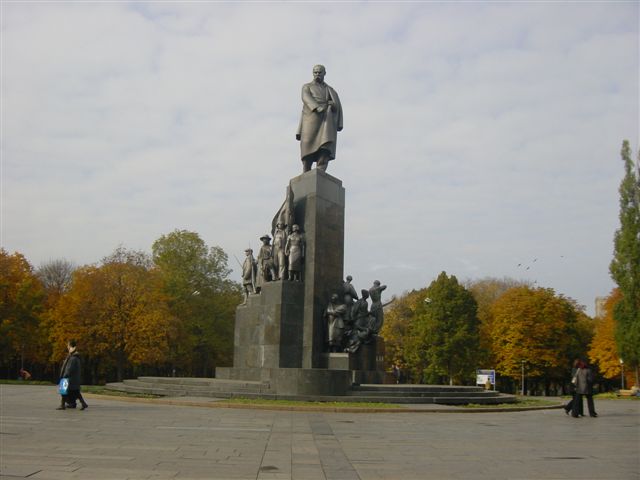
So, if he walks to the side of the monument, Mr. Yanukovych will find the following inscription, in Ukrainian: "When will Ukraine have its Washington with fair and just laws? Someday we will!"
In our nation's capital, these words are etched on a monument. Yet in Ukraine, since Shevchenko first wrote these words in 1857, they have been etched on people's souls. These words still express, unequivocally, eloquently and directly, the goal of the people of Ukraine and help give context to Ukraine's civil society today. Not only do Ukraine's elected leaders need to pay attention, it is time also for the West to get the message.
The West must judge Ukraine on its own merits. Active support should be provided for the new president's stated objective for Ukraine and Russia to have cordial relations, yet for Ukraine to set its own course. Since Ukraine cannot change its geography, good relations with neighbors are imperative. However, Bonn, Brussels, and Washington need to cast aside their fear that Ukraine pursuing separate interests from Russia is a threat, just because Moscow claims it is a threat.
The people of Ukraine understand that in order for their country to become political and economically stable, the prevalence of widespread corruption has to be eliminated. The West must help the people of Ukraine receive their fair and just laws. We need to help Ukraine's maturing civil society develop the political mechanisms to help keep political officials accountable.
[return to index] [Action Ukraine Report (AUR) Monitoring Service]
9. NARROW YANUKOVYCH VICTORY IN UKRAINE ELECTION
Washington, D.C., Wed, February 17, 2010
Although running 10 points ahead of Tymoshenko in the 17 January first round, Yanukovych only ecked out a 3 point margin in the 7 February runoff, even falling short of 50% (Cvk.gov.ua). (1)
Candidate First Round--votes Percentage Runoff--votes Percentage
Yanukovych
8,686,751
35.32%
12,480,053
48.96%
Tymoshenko
6,159,829
25.05%
11,589,638
45.47%
margin
2,526,922
890,415
Neither candidate reached 50%, as 4.36% of voters voted against both. (In the first round, 2.2% voted against all candidates (Cvk.gov.ua). (2)) The highest "against all" vote in the runoff was in Kyiv city, with 8% (Ukrayinska Pravda, 7 February). (3)
Yanukovych won by rolling up bigger margins in the east and south than Tymoshenko could roll up in the west and center. Yanukovych margin
Tymoshenko margin
In the east
5,252,774
In the west
3,400,470
In the south
1,879,051
In the center
2,828,995
Total (east and south)
7,131,825
Total (west and center)
6,229,465
Yanukovych's victory was based on an overwhelming margin (over 90%) in his home oblast of Donetsk -- Ukraine's biggest oblast -- and neighboring Luhansk (almost 89%) -- a 3,392,000 margin.
Oblast Yanukovych Percentage Tymoshenko Percentage Margin
Donetsk
2,435,522
90.44%
173,820
6.45%
2,261,702
Luhansk
1,237,922
88.96%
107,523
7.72%
1,130,399
Total
3,673,444
281,343
3,392,101
Yanukovych's victory in other eastern oblasts was not as lopsided: 62.7% in Dnipropetrovsk, 71.5% in Zaporizhzhya, and 71.35% in Kharkiv. The five eastern oblasts together have about 33% of the total national vote and with the south (Crimea, Sevastopol, Mykolaiv, Odesa, and Kherson) make up almost 47% of the national electorate. Result Reinforces East-West Split
Yanukovych's inability to get many votes in the west (he won only 6% -- 794,416) and dependence on the east and south (74% of his vote) reinforced Ukraine's east-west split, as western Ukrainians still refused to vote for him. Yanukovych had to win by the weight of the overwhelming margin of votes in the populous east. In some districts in Donetsk he got over 93%. (a)
In the runoff, Yanukovych raised his 35% in the first round to near 49%, adding 3,793,302 votes to his first round 8,686,000, but this was mainly by adding votes from the east (1,831,000). He only attracted an additional 230,000 votes from the west in the runoff. Tymoshenko Camp Alleges Falsification, Won't Recognize Results
Tymoshenko and her party leaders refused to recognize Yanukovych's victory, alleging widespread vote fraud in Donetsk, Luhansk, and Crimea.
On 8 February, she told a closed meeting of her faction that "I will never recognize the legitimacy of Yanukovych's victory in such an election" and that she had ordered lawyers to prepare to dispute the results in court (Ukrayinska Pravda, 8 February). (4) She said she would seek invalidation of the runoff and holding of a third round, as in the 2004 presidential election, arguing that "in the second round in 2004 the gap between Yanukovych and Yushchenko also was 900,000, but today we encountered falsification which I didn't even see then" (Ukrayinska Pravda, 10 February). (5)
After several days of public silence, on 13 February she gave a TV speech taking a hard stand, flatly declaring the election fraudulent and that she will never recognize Yanukovych's election. She said she has been "gathering evidence" and "working with lawyers" and "today I can firmly say to you that the election in Ukraine was falsified." She cited Crimea, where with the help of the courts her representatives were able to get a recount and "we were shocked by the fact that in all, without exception, polling stations it was legally established that there was falsification of from 3% to 8% in favor of Yanukovych."
Her close ally, Deputy Premier and head of her election staff Oleksandr Turchynov, said her party would challenge the results in Donetsk, especially at polling stations where her representatives were allegedly excluded (ITAR-TASS, 7 February). (7) Turchynov alleged Yanukovych's Party of Regions took total control of three districts in Donetsk (41, 42, 62), where local officials rejected the election representatives selected by her party (UNIAN, 7 February). (8)
BYuT (Bloc of Yuliya Tymoshenko) Rada deputy Sergey Vlasenko said BYuT will demand a recount at all polling stations in Donetsk, Luhansk, and Crimea (ITAR-TASS, 10 February), (12) while BYuT deputy Andriy Senchenko asserted that a fourth of the votes for Yanukovych in Crimea were falsified, up to 200,000 votes (Ukrayinska Pravda, 11 February). (13) Tymoshenko Determined To Keep Post of Premier
Although Yanukovych stated that he expects to replace Tymoshenko as premier, she has repeatedly insisted she will not resign, arguing the constitution does not require a change of government after election of a new president.
Yanukovych immediately after the election called on Tymoshenko to recognize defeat and also to resign as premier, to allow a new government to be formed.
In a message on his website, Yanukovych said "I call on the premier to resign and move into opposition ...to enable me to start negotiations with various factions regarding formation of a new cabinet" (Kanal 5, 10 February). (14)
Party of Regions deputy head Anna Herman called on BYuT to recognize that "the resignation of the Tymoshenko government is unavoidable" (Glavred, 12 February). (15)
After Tymoshenko's hardline 13 February speech, Yanukovych said her past poor work left her "no chances to stay at this post" (ITAR-TASS, 14 February). (16)
However, Tymoshenko and her associates declared she had no intention of resigning.
Turchynov declared: "There are no grounds for the government to resign on its own initiative" (ITAR-TASS, 11 February), (17) and BYuT deputy Andriy Shkil said Tymoshenko would remain premier until a new coalition is formed in the Rada that can approve a new premier, "but now we see no grounds for resignation" (Obkom, 10 February). (18)
Tymoshenko demonstrated her determination to keep her post as premier by appealing on 16 February to Yushchenko's Nasha Ukrayina and Rada Speaker Volodymyr Lytvyn's Bloc to continue their coalition with her BYuT and thereby prevent Yanukovych forming a new coalition to install a new premier. Meeting with the Nasha Ukrayina faction, she continued to insist that she does not have to resign unless or until Yanukovych can form a majority to approve a new premier (Interfax, (19) ITAR-TASS, 16 February (20)). (b)
According to the constitution, the cabinet is to resign when a new president is elected, however the cabinet continues in office until a new premier is approved by a majority in the Rada. Therefore, Tymoshenko would continue until Yanukovych can form a new coalition (Nezavisimaya Gazeta, 9 February). (21) Politcom.ru observer Igor Bunin pointed out the difficulty of forming a new coalition since it must be formed of factions, not of individual defectors from factions.
Yanukovych May Need To Compromise With Tymoshenko
With Yanukovych's weak electoral victory and the difficulties of cobbling together a majority in the Rada to replace Tymoshenko, some observers, even Russians, suggested that Yanukovych may find it necessary to compromise with Tymoshenko, perhaps even leaving her as premier.
Ukrainian observer Volodymyr Fesenko stated that "no one's presidency in Ukraine ever began in such complicated circumstances" and so Yanukovych "must reconsider his views and seek compromise with Tymoshenko" to avoid the risk that his victory "remains unrecognized by half the country" (Nezavisimaya Gazeta, 9 February). (23)
Russian observer Oleg Gorbunov wrote that Yanukovych's narrow victory raises various problems and that "apparently the solution is achieving a compromise between the main political forces in the country, primarily between BYuT and the Party of Regions" (Politcom.ru, 11 February). (24)
Russian observer Vitaliy Portnikov wrote that it will take time to form a new coalition and oust Tymoshenko as premier and holding a new parliamentary election does not guarantee Yanukovych a new majority. "So, perhaps, one should reach agreement with Tymoshenko, trade her recognition of the results of the presidential election for a 'grand coalition'" with her. Portnikov asked "isn't this what the premier is striving for? So, as they say, Tymoshenko cannot lose" (Politcom.ru, 11 February).
Moscow observer Avtandil Tsuladze argued that the "minimal gap between Tymoshenko and Yanukovych ... rules out the situation under which the winner gets all." Yanukovych has to "overcome the split in the country" and "this is possible in only one case -- if Tymoshenko remains as premier under President Yanukovych." (Yezhednevnyy Zhurnal, 9 February). (25)
Prominent Ukrainian political commentator Mykhaylo Pohrebinskyy declared Yanukovych is in a no less complicated situation than the loser Tymoshenko: "Every day he calls on Tymoshenko to resign from the post of premier -- this is already comical. She does not leave, and he cannot get rid of her -- for this he needs the agreement of a parliamentary majority not only to vote for her removal but to approve a new composition of the government."
Yanukovych will apparently have to reach beyond his Party of Regions in choosing a new premier in order to add enough deputies to form a majority. Although most Nasha Ukrayina deputies at present seem inclined to stick with Tymoshenko (UNIAN, 16 February), (27) some suggest naming a Nasha Ukrayina premier like Yuriy Yekhanurov or an acceptable neutral like Serhiy Tihipko could incline them to join a coalition with the Party of Regions (Obkom, 16 February; (28) Interfax, 9 February (29)).
But some observers argued that with the continuing divisions in Ukraine, instability will continue in any case.
Russian observer Igor Bunin concluded that "whatever scenario of events develops in Ukraine -- whether creation of a coalition with the participation of Nasha Ukrayina and appointment of a compromise premier or an early (Rada) election -- any variant keeps a situation of political instability for a long time in Ukraine" (Politcom.ru, 15 February). (30)
Ukrainian website From-ua argued that the president's power is limited, as President Yushchenko's extended struggles with his premiers (Tymoshenko and Yanukovych) showed, and so "if Ukrainian voters think that with the conclusion of the presidential election the country has entered peace and quiet, they are deeply mistaken. The war for power continues, and the most scandalous scenes await us in the future" (From-ua, 12 February). (31) [Footnotes not included here]
[return to index] [Action Ukraine Report (AUR) Monitoring Service]
========================================================
10. PUTIN SHOULD BEWARE OF KIEV POLL AFTERTASTE
For Vladimir Putin the results of the Ukrainian presidential election are sweet. But the Russian prime minister should savour the success of Viktor Yanukovich with some care - there may yet be a strange aftertaste.
At first lick, there should be nothing to disturb Mr Putin. President Viktor Yushchenko, Kiev's pro-west champion, has been comprehensively beaten, losing in the first round with barely 5 per cent of the vote - a humiliation for the Nato-supporting Orange Revolution hero.
Mr Yanukovich, who overcame the glamorous Yulia Tymoshenko in Sunday's final round, is the most Russia-friendly of the top candidates, even if his sympathies are outweighed by dependence on his real masters, Ukraine's industrial billionaires.
To add spice for Mr Putin, this is the same Mr Yanukovich who lost in 2004 when he was Moscow's publicly backed candidate. The gaffe-prone former convict is not exactly the ex-KGB colonel's best mate. But he owes the Kremlin a few favours.
Mr Yanukovich's victory will probably not mark any dramatic Russia-oriented shift in foreign policy. The big change came in 2008, when Nato decided against extending membership to Ukraine (or Georgia) for fear of offending Russia. The point was rammed home during the Georgia war. For Mr Yushchenko, who had earlier discovered that the European Union did not want Ukraine as a member either, it was the end of a dream.
Subsequently, Kiev took a more balanced approach. With Mr Yushchenko in retreat, Ms Tymoshenko, as prime minister, developed relations with Mr Putin at the same time as promoting EU integration. With Mr Yanukovich there will be a bit more Russia in the mix but the two-track policy will remain in place.
But beneath the surface there are hidden dangers for Mr Putin. The most important challenge of the Orange Revolution was not the threat of Ukraine breaking away from Moscow and joining the west. That was unlikely, given the myriad ties between the two countries. And if events ever had moved in that direction, Russia had powerful tools at its disposal, such as fomenting separatism in Crimea.
What really disturbed Mr Putin was the Orange Revolution's potential political impact within Russia. It was a democratic challenge, albeit indirect, to his authoritarian structures. With protesters overthrowing leaders at around the same time in Georgia and Kyrgyzstan, it was possible to believe liberalisation was sweeping the former Soviet Union - and that the ultimate target could be Russia.
In the event, the new regime in Kyrgyzstan proved little different from the old. In Georgia, Mikheil Saakashvili, the president, allowed himself to be drawn into a disastrous war. In Ukraine, as Mr Putin never ceased to point out, the Orange Revolution was followed by chaos.
The circumstances of the Orange Revolution - the protests, the blatant foreign involvement by Russia and the west and the subsequent turmoil - made it easy for Moscow to portray democracy as a mess. But this time it could be different. If Mr Yanukovich can create a stability - a big if - and generate economic recovery - an even bigger if - it will be harder for Mr Putin to argue Russia has nothing to learn from Ukraine.
This is not an issue for today. Even though Russians are angry with the recessionand some blame the authorities for their woes, there are no serious threats to Mr Putin's grip on power. Recent demonstrations in the Kaliningrad region and sporadic protests elsewhere do not change the picture. And no one looks to Kiev for advice.
But who knows about the future? Mr Putin and his protégé, President Dmitry Medvedev, do not run a totalitarian state but an authoritarian system in which some argument is tolerated. Every so often, there is a note of real dissent.
Could Ukraine one day serve as an example of such a "civilised society", even in Russian eyes?
[return to index] [Action Ukraine Report (AUR) Monitoring Service]
========================================================
As he spoke in an interview with the Rossiya Channel prime-time news and analysis program, he made it clear he believes that the U.S. exerts a decisive impact on the situation in Ukraine.
"I think they /the Americans/ will find it increasingly more difficult," Gorbachev said. "If the Ukrainians were do decide things on their own, they would certainly pursue the policy of leveling out the relations with Russia."
He believes relations between the countries like Russia and Ukraine should be free of any major problems. "There exist two well-shaped countries, Russia and Ukraine," Gorbachev said. "They have border, on which everyone has agreed, and so let's live normally and do all the rest on the basis of agreements."
He admitted that the restoration of the Soviet Union is impossible now and added that he "was glad when the idea appeared of setting up a common economic space comprising Russia, Belarus, Ukraine, and Kazakhstan."
These four countries account for 80% of the former USSR's economic potential, and "that's quite enough," Gorbachev said. "Still, very many people wouldn't like to see Russia and Ukraine's unification," he said. "Let's begin with the U.S. to avoid enumerating all the rest."
[return to index] [Action Ukraine Report (AUR) Monitoring Service]
========================================================
KIEV, Ukraine Outgoing President Viktor Yushchenko said Tuesday the policies of his newly elected successor risk turning Ukraine back into a Kremlin vassal state.
Yushchenko made the statements, some of his harshest against President-elect Viktor Yanukovych, at a news conference nine days before he is due hand over power. "The victory of Yanukovych is a Kremlin project. It is a policy of deep dependence on Russia," Yushchenko said.
Yushchenko was the leader of mass street protests in 2004 against Yanukovych's Kremlin-backed election victory that year. Dubbed the Orange Revolution, those demonstrations urged the Supreme Court to overturn Yanukovych's fraudulent win and call for a revote, which Yushchenko won.
Since then, Yanukovych has capitalized on Yushchenko's ineffectual rule, the slow progress of European integration, and the economic meltdown of the past year. He won the presidential ballot Feb. 7 against the heroine of the Orange Revolution, Prime Minister Yulia Tymoshenko.
Yushchenko saved particular venom for Yanukovych's plans to give Russia a stake in managing Ukraine's natural gas pipelines and to extend the lease Russia has on a Black Sea naval base.
"It is painful and demeaning for me to hear these pledges. It discredits us as a nation, as Ukrainians," Yushchenko told a sparsely attended briefing, appearing dejected but calm.
Yushchenko has fought bitterly to kick out Russia's Black Sea fleet, which he sees as a threatening military presence on Ukrainian soil. He called Yanukovych's pledge to allow the fleet to stay a "policy of being colonized."
In a statement, Yanukovych responded to Yushchenko's attack with a pledge to pursue a balanced and pragmatic foreign policy. "I can only say one thing to anyone who expects my presidency to weaken Ukraine don't count on it," Yanukovych said.
---------------------------------------------------------------------------------------
[return to index] [Action Ukraine Report (AUR) Monitoring Service]
========================================================
13. BULGAKOV IS ONCE AGAIN OUR GUIDE TO UKRAINE
Analysis & Commentary: By Misha Glenny
If you are struggling to make sense of the latest twists in Ukraine's political drama, you could do worse than book tickets for the new adaptation of The White Guard at London's National Theatre. Set in the Kiev of 1918, Mikhail Bulgakov's masterpiece reveals the terminal pain of the Turbins, a likeable if flawed White Russian family sinking steadily under the weight of the violent ideological conflict that wracked the Ukrainian capital during the Russian civil war.
----------------------------------------------------------------------------------------
[return to index] [Action Ukraine Report (AUR) Monitoring Service]
========================================================
14. UKRAINE'S RADICALLY DIFFERENT CONFLICT
In the Kiev of 1918, Bulgakov was witnessing the unprecedented social upheaval born of the collapse of the Romanov empire and the Russian revolution. At the heart of it was the violent struggle between various political forces over the scope of social transformation and over how to define Ukraine as a political entity. It is utterly misleading to contend that the messy politics that we are witnessing today is a kind of repetition of the 1918-19 events.
[return to index] [Action Ukraine Report (AUR) Monitoring Service]
========================================================
========================================================
The best commentary on Ukraine's presidential election outcome I have heard is from a colleague with lots of experience in the country and region: For ten years, Ukraine has been a disappointment to the West; now it is Russia's turn.
Many commentators think Moscow somehow "won" in Ukraine. Certainly, Russian interests did not lose, but that would have been the case with Tymoshenko.
[1] First, Ukraine is a mess. It inherited all the problems of other former Soviet states.
Next, Yanukovich will hardly be a strong leader and will need to compromise all the time just to maintain some kind of coalition in the Rada. Yanukovich pretty much came back from the political dead of four years ago, but he owes many people for his resurrection, and they will want the debts paid, big time.
Then, the fact remains that most Ukrainians even those who speak only Russian want Ukraine to remain independent of Russia both in name and in fact. Those in Moscow who envision a voluntary anschluss are dreaming. Even the big eastern Ukrainian oligarchs who bankrolled Yanukovich think of themselves as European, and certainly do not want to be junior-league Russian oligarchs.
Moscow can take gratification on some things.
[1] First, Viktor Yushchenko has exited the political stage. In recent years, the departing Ukrainian president has alienated all but his most stalwart supporters, and provoked rumors that the poison which disfigured his face also damaged his mind. The man has long had something of a messiah complex, but his behavior became not only erratic but profoundly damaging for the most basic interests of his country.
[2] Second, NATO membership for Ukraine is a dead issue for years to come, but in reality it already was because the people of the country decisively do not want it. It may very well come to pass that Ukrainian cooperation with NATO within Partnership for Peace may increase, as the question of MAP status is now off the table. Certainly, Ukraine will pursue the best ties it can get with the European Union, enjoying the advantage of WTO membership (still on the horizon for Russia).
[3] Third, a base deal on Sevastopol which meets Russia's requirements is likely, but the broader question of Crimea remains, and this is a question on which no Ukrainian leader can compromise.
Finally, elections change politicians but not underlying realities. The Ukraine which emerged from the Soviet collapse is the widest country in Europe, both in geography and in political culture. Any government in Kyiv with good sense must balance not only the country's external west/east orientation but its internal west/central/south/east composition. Ukraine ultimately can never again belong to Russia because Russia has lost its legitimacy as Slavic hegemon.
[return to index] [Action Ukraine Report (AUR) Monitoring Service]
========================================================
16. COULD PARTITION SOLVE UKRAINE'S PROBLEMS?
Ethan S. Burger has been following events in the Soviet Union and its successor states for over 20 years. He is an Adjunct Professor at the Georgetown University Law Center.
In the light of Ukraine's election result, Ethan S. Burger offers a proposal for the creation of a new Ukrainian state. Partition would do more than better reflect the country's national/ethnic composition, he suggests. It could also make the country economically viable, while enhancing European stability.
What of Ukraine's future now? The country's Central Election Commission has announced that the leader of the Party of the Regions Viktor Yanukovich has been elected president in the second round of voting. Despite Prime Minister Yulia Timoshenko's claims to the contrary, the Organization for Security and Cooperation in Europe (OSCE) has announced the elections to be fair.
The Ukrainian economy is in terrible shape. Loans and technical assistance from the European Union, international organizations and the United States have had a very limited economic impact on a country plagued by corruption. Much of the Ukrainian population is suffering financially.
The last two Ukrainian presidential elections suggest how strong a role national identity appears to play in determining voting behaviour. Last Sunday, as in 2004, Viktor Yanukovich received a majority of votes in Eastern Ukraine, where most of the population has a closer affinity to Russia than to Western Europe.
Western Ukraine used to be referred to as "New Russia," in recognition of the fact that these lands were only added to the Russian Empire through conquest in the 17th and 18th centuries. With respect to political attitudes, the majority here seem to hold views which are closer to those of Poles than Russians. Still, the Russian/Ukrainian linguistic/national distribution in the country is not uniform.
The issue of self-identity is complex. But it is no accident that Mr. Yanukovich has more appeal to Ukrainian citizens of Russian national origin than does Ms. Timoshenko, the catalyst behind the so-called Orange Revolution, which has disappointed popular expectations.
Collective nouns and generalizations can be misleading. It is indisputable that Ukraine has a complex ethnology. No less than 17% of Ukraine's population are of Russian national origin and are primarily Russian-speaking. A fair segment of the population is either bilingual, or ethnically mixed (usually with one parent who considers themselves "Russian" and the other "Ukrainian"). These people tend not to see the choice of language as a political issue so much as a means of communication.
In Western Ukraine, the majority are Ukrainian speaking. While they may understand Russian and speak it when necessary , they tend to see the preservation of Ukrainian culture, history and language as a priority. In addition, Ukraine has other nationalities such as Crimean Tatars, Greeks and others.
Still, it would be a mistake to assume that nationality was a decisive factor in the recent electoral outcome. Ms. Timoshenko was viewed negatively by many of the country's population -- including Mr. Viktor Yushchenko, the country's ineffective president, who finished fourth in the first round of voting and cast his vote in the second round for "none of the above".
Mr. Yushchenko hoped that closer ties to the West would produce a vibrant Ukrainian economy. He was wrong. For a start, Ukraine is substantially dependent on Russia for its energy. Yushchenko was also unable significantly to reduce government corruption. Russia did not hide its hostility to his remaining in office.
So what of Ukraine's future? Clearly, the election result must be viewed as a foreign policy success for the Kremlin. It looks as if Russia will have a satellite on its southern frontier -- it is doubtful whether either the Russian leadership or Mr. Yanukovich would risk Russian absorption of Ukraine.
The argument for partition
On the other hand, Ukrainians who are apprehensive over the country's future might consider division of the country. This would be difficult to
accomplish, and it might provoke a good deal of instability. It would be particularly hard to decide exactly where precisely to partition the country. But the alternatives might be worse.
On the positive side, for those Ukrainians who regard the prospect of renewed subordination to Moscow with repugnance, it would provide an opportunity to create a new state more consistent with their desires. The Russian government might even favour the idea. It could be accomplished through a referendum overseen by the OSCE.
International borders are often arbitrary and, over time, never permanent. While they may reflect the topography of the land, more often than not they are a product of political whim or of military force. Most countries have regional differences within their borders. But borders have real consequences for history, for language, nationality, politics and religion. This may be the reason why Ukrainian law prohibits dual citizenship -- to prevent ethnic Russians from undermining Ukrainian independence and effecting reunification with Russia.
It has been approximately 18 years since the Soviet Union's break-up and the re-emergence of the Ukrainian state. Despite the claims of many official statements, polls and sociological surveys, Ukraine has not completely solved its nationality problem. The present situation has certain parallels with Yugoslavia during the 1970-80s.
Nor is successful partition without precedent in recent history. In 1993, Czechoslovakia split peaceably into the Czech Republic and Slovakia. Both countries now pursue their separate courses, while moving in the same general direction politically. The Czech Republic has a small Slovak minority, while Slovakia has a small Hungarian minority. All three, the Czech Republic, Hungary and Slovakia, are members of both the EU and NATO.
Last, but by no means least, it might prove possible for the West to prop up a smaller Ukraine whose government were committed to the goal of Western development.
========================================================
17. UKRAINE'S POST-ELECTION "TO-DO" LIST
Washington, D.C., Thursday, February 11, 2010
Tymoshenko, of course, has every right to pursue her legal options, but it would be unfortunate if her efforts led to weeks of squabbling and political paralysis. Ukrainians have had enough of that over the past few years, when they grew disillusioned with those associated with the 2004 Orange Revolution.
[5] Avoid pressing on membership in NATO, especially since the majority of Ukrainians do not support NATO membership at this time. Injecting this issue into the political debate in Ukraine now would be distracting and counter-productive but NATO should keep its door open, too.
[6] Push for resumption of International Monetary Fund (IMF) lending if Ukraine's parliament and leaders stop their inflationary and unaffordable budgetary and fiscal policies.
For Yanukovych, he should:
[1] Appoint people to government positions based on experience and talent, not solely as payback for political favors, and include individuals from Tymoshenko's bloc. Choosing a replacement for Tymoshenko, should she leave or be voted out by the Parliament, will be especially important. After experiencing a nearly 15 percent drop in GDP last year, Ukraine cannot afford continued delays in fixing the economy.
[3] Visit Brussels and Washington sooner rather than later. There is a caricature of Yanukovych as the pro-Russian candidate. Visiting Western capitals would go some distance toward disabusing those suspicious of him.
[4] Pursue improved relations with Moscow, which deteriorated under outgoing President Viktor Yushchenko, but protect Ukraine's interests on issues concerning energy security and the Black Sea Fleet. Similarly, reject Russian pressure to recognize the separatist Georgian regions of South Ossetia and Abkhazia.
[6] Avoid a push for early parliamentary elections. Some in his party see this as a way to increase their control over the legislature. The last thing Ukraine needs is another election—the people here, despite impressive turnout numbers (68%) on Sunday, want to see their leaders govern effectively, not engage in endless electoral campaigns.
As a Senior Transatlantic Fellow, David J. Kramer works on issues related to Russia/Eurasia and wider Europe as well as democracy and human rights. He came to GMF after more than eight years at the U.S. State Department in various capacities, most recently as assistant secretary of state for democracy, human rights, and labor.
About GMF
The German Marshall Fund of the United States (GMF) is a nonpartisan American public policy and grantmaking institution dedicated to
promoting greater cooperation and understanding between North America and Europe. GMF does this by supporting individuals and institutions working on transatlantic issues, by convening leaders to discuss the most pressing transatlantic themes, and by examining ways in which transatlantic cooperation can address a variety of global policy challenges.
[return to index] Action Ukraine Report (AUR) Monitoring Service]
========================================================
You are welcome to send us names for the AUR distribution list.
========================================================
18. UKRAINE UNDER YANUKOVYCH: RELATIONS WITH THE EU
BRUSSELS - "In the immediate future [Viktor Yanukovych] needs to demonstrate that he is not a Russian stooge, so the EU should use this opportunity to strengthen relations with Ukraine, pushing for reforms but offering assistance," argues Amanda Paul, a researcher at the European Policy Centre, in a February paper.
----------------------------------------------------------------------------------------
[return to index] [Action Ukraine Report (AUR) Monitoring Service]
========================================================
========================================================
19. DEFENDING DEMOCRACY: TYMOSHENKO TAKES BATTLE TO THE COURTS
INFORM: Newsletter for the international community providing
views and analysis from the Bloc of Yulia Tymoshenko (BYuT)
Kyiv, Ukraine, Monday, Feb 15, 2010, Issue 141
KYIV - Prime Minister Yulia Tymoshenko has said that she will challenge the results of the presidential election in court following evidence of widespread fraud. On Sunday, the Central Election Commission (CEC) declared Viktor Yanukovych the next president and published results identical to the preliminary results announced last Wednesday.
The declared results confirmed a gap between Ms Tymoshenko and the Party of Regions leader Viktor Yanukovych of just 3.48 percent, which amounts to some 900,000 votes.
Pre-empting the official result, Ms Tymoshenko addressed the nation on Saturday. She thanked her supporters and explained that, since the election on 7 February, her team had been working with lawyers to collect and catalogue evidence of election falsifications to be presented in court.
In particular, the premier cited irregularities in the southern autonomous region of Crimea – a Russian-speaking stronghold of Mr Yanukovych – where she alleged 3-8 percent of votes were fraudulently given to him. She said that overall Mr Yanukovych's team had stolen more than one million votes, more then enough to sway the result in his favour.
A steely faced Ms Tymoshenko told TV viewers, "With all the evidence, I took the only possible solution - to challenge the election results in court." Acknowledging that Ukrainians were weary from years of political instability, she stressed the need for stability and calm. But she drove home her message, "Not going to the courts today would mean leaving Ukraine to criminals without a fight."
While election monitors were quick to declare the election process had been "free and fair," there has been growing disquiet that their proclamations were too premature, considering the fraud demonstrated by Mr Yanukovych's supporters five years ago.
"Yanukovych's team has learned much since 2004," said First Deputy Prime Minister Oleksandr Turchynov, "the falsifications we have witnessed are less obvious and much harder to verify, but they are there."
In her address, Ms Tymoshenko said that several observers from the Organisation for Cooperation and Security in Europe (OSCE) election monitoring mission supported her challenge and were concerned at "systematic fraud."
Last week the OSCE and other bodies gave the Ukraine election a clean bill of health. It did however voice concern over a major change in-between rounds in the election process.
Legislation hurriedly instigated by the Party of Regions dispensed with the requirement for a quorum of representatives from both sides to approve the count. It meant that in 38,000 polling stations nationwide, local Party of Regions commissioners had the power to sign-off the results without the approval from commission members from the Bloc of Yulia Tymoshenko (BYuT).
Yesterday the CEC said that it will not consider Ms Tymoshenko's complaints. Meanwhile, Ms Tymoshenko's representative at the CEC said that they will take the issue to the courts. He confirmed there are 43 cases in the Kyiv court of appeals concerning the inaction of the CEC in considering complaints. Going through the courts will be an uphill struggle for Ms Tymoshenko. Both the CEC and the courts are staffed predominantly by Party of Regions-run officials.
"I very well know, as you do, the quality of our courts. But at the same time, I have a responsibility to you and the country to fight for the restoration of justice," said Ms Tymoshenko.
REPORTED ELECTION IRREGULARITIES
[1] Unusually high number of ballots with votes cast for Ms Tymoshenko intentionally damaged and therefore invalidated.
[2] With the help of local government bodies, parallel lists of voters were drawn up in the Donetsk and Luhansk regions, enabling voters to vote twice.
[3] Numerous changes in the voter list were made on the day of voting in violation of the law.
[4] Cases of voting by election commissioners or other voters for other persons not present at the polling station.
[5] Artificial increase in the turnout in Eastern regions of Ukraine caused by the transport between voting precincts of voters organised by the Party of Regions. Furthermore, intensive campaigning on the day of elections is in violation of the law.
[6] Numerous violations in the PEC protocols submitted to the DECs; violations of requirements on the corrections in the PEC protocols.
[7] A suspiciously high number of voters who voted from home (more then 1 million), many of whom did not have permission to do so. A high incidence of home voting based on applications written in the same handwriting.
[8] Counting of damaged ballots in favour of Viktor Yanukovych in the southern and eastern regions of Ukraine.
NOTE: Questions or comments? Email the Inform Newsletter at nlysova@beauty.net.ua.
--------------------------------------------------------------------------------------
[return to index] [Action Ukraine Report (AUR) Monitoring Service]
========================================================
20. THE REVOLUTION IS DEAD. LONG LIVE THE REVOLUTION
Just because the Orange revolutionaries lost in Ukraine, doesn't mean their cause did.
Analysis & Commentary: By David J. Kramer, Foreign Policy, Wash, D.C., Mon, Feb 8, 2010
Ukrainian opposition leader Viktor Yanukovych's apparent victory in yesterday's presidential election over Prime Minister Yulia Tymoshenko -- at last count, he had about a 3 percent lead and was pushing Tymoshenko to concede -- has many observers ready to proclaim the death of the Orange Revolution.
Indeed, the revolution's hero, Viktor Yushchenko, got less than 6 percent of the vote last month in the election's first round. If his prime minister, Tymoshenko, loses too, the election will certainly mark a reverse-changing of the guard. This year's victor, Yanukovych, was the very leader ousted after hundreds of thousands of Ukrainians took to the streets of Kiev in chilly November and December, 2004.
Nothing like that is expected this time because much has changed since 2004. And despite its apparent reversal, the Orange Revolution is partly responsible for the much improved climate this time around.
For sure, Ukrainians have good reason to feel disappointed with what became of the Orange Revolution of 2004; its dreams were never realized, leading to tremendous disillusionment among Ukrainians and observers in the West. President Yushchenko's dismal showing in the first round reflected the population's strong disapproval of his leadership.
Tymoshenko, Yushchenko's erstwhile Orange Revolution partner, also bore responsibility as current prime minister -- overseeing a disastrous economic performance last year that saw GDP decline nearly 15 percent. Even in Europe and Washington, "Ukraine fatigue" had set in.
So now, five years after so many Ukrainians went to the polls to enthusiastically vote for their candidate, this time around many held their nose while casting their ballots, voting as much against Yushchenko as for a candidate. Turnout in the first round, while lower than in 2004, was a respectable 67 percent; in the second round, it was 68 percent. (Ukrainians, trained during Soviet times to turn out to vote, still take their civic responsibility seriously, even in freezing cold temperatures.)
But while less invigorating than the 2004 campaign, this year's vote was also quite a bit cleaner. Last time, the leading opposition candidate, Yushchenko, was poisoned with dioxin; those responsible have still not been held accountable. The media in 2004 operated in a climate of fear and were given orders from the administration on what to write and report. The party in power engaged in massive electoral abuse, for example by spending state resources to support the candidacy of the incumbent, Yanukovych.
Russia weighed in -- in an incredibly heavy-handed manner, providing some $600 million in support of Yanukovych's campaign. As if the message wasn't clear enough, Russian President Vladimir Putin stood at Yanukovych's side twice during the race to demonstrate his country's support for the incumbent, once during a military parade down a main street in Kiev. Of course, Moscow's support eventually backfired as Ukrainians decided that they (not the Russians) should choose their leader.
No such funny business was repeated this time around, nor during parliamentary elections in 2006 and 2007. None of the candidates faced harm or intimidation. The media are today the freest and most diverse in the former Soviet Union. Although some journalists are still on the payrolls of candidates and business interests (it doesn't help that oligarchs own most of the TV stations), they are free to slam the government and candidates at will -- without fear for their lives.
Administrative abuses have been minimal, evidenced by the fact that the sitting president came in an embarrassing fifth place. And even Russia largely stayed on the sidelines, having learned its lesson the hard way five years ago. Besides, this time Moscow seemed ambivalent between the two front-runners. As one observer put it, Moscow likes Tymoshenko but doesn't trust her; they trust Yanukovych more but don't like him.
All these positives add up to an election that is fundamentally different from the 2004 vote. This is in fact the third ballot, after the two parliamentary ones in 2006 and 2007, to have passed the test of international election observers. In other words, Ukraine has shown that it knows how to conduct good elections in a relatively democratic space. That neither candidate in this second round was terribly appealing should not detract from the gains that have been made over the past five years.
NOTE: David J. Kramer is senior transatlantic fellow at the German Marshall Fund of the United States in Washington. He headed the International Republican Institute's election observation delegation to Ukraine's second round of the presidential election. He writes here in a personal capacity.
[return to index] [Action Ukraine Report (AUR) Monitoring Service]
========================================================
Please contact us if you no longer wish to receive the AUR.
21. IN UKRAINE THE NEXT POLITICAL WAR BEGINS
BOSTON - On 16 February, Ukraine Prime Minister Yulia Tymoshenko made good on earlier statements by officially filing documents with the country's Supreme (Higher) Administrative Court to overturn the country's presidential election results. (1)
Ihor Zhdanov, a former close ally of President Viktor Yushchenko and one of Ukraine's more respected political analysts, suggests that Tymoshenko's key evidence includes a reported increase of around 300,000 individuals on the voter lists on election-day. (6)
Following round one of the election, the European Network of Election Monitoring Organizations also cited concern about an increase of 400,000 people on the voter lists on that election-day. (7) It is unclear how or why hundreds of thousands of voters came to be added only as votes were being cast during round one and round two.
So, while Tymoshenko is unlikely to win the court battle over election results, it appears she already has made significant progress in the new political war for power and influence.
Source Notes:
(1) "Ukraine's PM Lodges Appeal," Reuters/Montreal Gazette, 17 Feb 10 via http://www.montrealgazette.com.
(3) "Court Suspends Ukraine Vote Results," AP/Moscow Times, 18 Feb 10 via www.moscowtimes.com.
(5) "Court Suspends Ukraine Vote Results," AP/Moscow Times.
(6) "Experts on Tymoshenko chances to win lawsuit," Zik-Western Information Agency.
(7) Ukraine Presidential Election, Report on Pre-Election Period, January 18-February 4 2010, page 2, via
(9) Ukrayinska Pravda, 1616 CET, 15 Feb 2010 via http://www.pravda.com.ua/news/2010/02/15/4773483/.
CONTACT: Tammy Lynch (tammymlynch@hotmail.com)
[return to index] [Action Ukraine Report (AUR) Monitoring Service]
========================================================
22. INSIDE UKRAINE: YANUKOVYCH UNCOVERED
Inside Ukraine #5, International Centre for Policy Studies (ICPS)
Kyiv, Ukraine, Thursday, February 18, 2010
KYIV - Dear colleagues, please find at the following links the February issue of Inside Ukraine "Yanukovych Uncovered," http://www.icps.com.ua/eng/index.html or http://www.icps.com.ua/files/articles/55/63/Inside_Ukraine_ENG_5_Febr_2010.pdf
The official results of the run-off election announced by the Central Election Commission made Viktor Yanukovych the new President of Ukraine. The
OSCE and other international observers concluded that Ukraine's election was fair and transparent and world leaders have already congratulated the
President-elect. Still, uncertainty about how the political situation might evolve in Ukraine remains high.
In this special issue of Inside Ukraine, ICPS takes a revealing look at Viktor Yanukovych. We do a little reality check on major myths about Mr.
Yanukovych. We look at the challenges that the new President will face, appointments he may make, the foreign policy agenda that he will push
through, and the domestic policies he will have to back or oppose.
We also suggest 7 tests for Mr. Yanukovych that will allow both Ukrainians and the international community to understand where Ukraine is heading.
Enjoy, Olga SHUMYLO, Director, International Centre for, Policy Studies, Kyiv, Ukraine, http://www.icps.com.ua/eng/index.html
---------------------------------------------------------------------------------------
========================================================
23. CURING 'UKRAINE FATIGUE'
Op-Ed, By Steven Pifer, The New York Times, NY, NY, Tue, Feb 9, 2010
If Viktor Yanukovich, the winner of the presidential race in Ukraine, acts quickly to address his country's pressing problems, he could move it out of
the doldrums and cure the "Ukraine fatigue" afflicting Washington and most European capitals.
As Viktor Yushchenko exits the presidency, Ukraine faces a host of problems. It suffered a crushing 14 percent fall in gross domestic product in 2009.
Unwise pricing policies and widespread corruption have put the critical gas sector in virtual bankruptcy. The nasty in-fighting between Mr. Yushchenko
and his prime minister, Yulia Tymoshenko, kept Kiev from implementing needed
responses to these challenges.
As a result, Ukraine fatigue has again gripped the West. This malady first broke out in 1998 in the U.S. Congress. American legislators, weary of the
slow pace of reform and mistreatment of U.S. investors, scaled back their generous assistance earmarks for Kiev. A subsequent outbreak was cured by
the 2004 Orange Revolution, as Ukrainians inspired the West with a determined defense of their right to have their votes counted fairly.
Unfortunately, Mr. Yushchenko and Ms. Tymoshenko, close allies during the Orange Revolution, could not cooperate in power and failed to build on the
revolution's promise. Ukraine fatigue returned with a vengeance. The country has ceased to be a priority for the European Union and, given everything now
on the Obama foreign policy plate, barely registers on Washington's radar.
Mr. Yanukovich's victory on Sunday rings with irony. After all, the Orange Revolution threw out his tainted election. But the Ukrainian electorate has
given him a new chance. He now has an opportunity — and the responsibility — to show he can provide the decisive leadership his country needs.
irregularities has emerged, and international observers praised the election for meeting democratic standards, now the norm for Ukraine. The West should
congratulate and engage Mr. Yanukovich, and urge him to get on with addressing Ukraine's daunting problems.
A serious attack on corruption would create better conditions for both Ukrainian and foreign businesses. Reforming the gas sector would strengthen
Ukraine's energy security and benefit Europe: Gas spats between Kiev and Moscow have twice in the past four years halted gas flows to Europe.
Coherent policymaking in Kiev would give Western capitals something with which to work.
Tackling this reform agenda will require tough decisions by Ukraine's new leadership. The United States and European Union should jointly send a
message to Kiev containing three key points:
[1] First, the West welcomes Mr. Yanukovich as the democratically elected leader of Ukraine. However, a reversal of the democratic progress that Kiev
has made in the past five years would have profoundly negative consequences for relations with the West.
[2] Second, the West understands that Mr. Yanukovich's foreign policy may differ from his predecessor's. The doors to integration and cooperation with
institutions such as the European Union and NATO nevertheless will remain open; Kiev should indicate how far and how fast it wishes to proceed.
[3] Third, the West will assess his seriousness by the seriousness of his policies. The West cannot want Ukraine to succeed more than Ukrainians do.
Should Mr. Yanukovich avoid crucial actions such as energy sector reform, that is his choice — even an understandable one given the tough politics
that surround the issue. The West will still seek good relations. But Washington and Brussels should make clear that in such circumstances, Kiev should not expect the West to extend itself by intervening, for example, with the International Monetary Fund to cut Ukraine slack on meeting its loan obligations.
The goal should be to encourage Kiev to take steps that will make Ukraine more democratic, more stable and more capable of fending for itself. That will advance the country's interests and make it a better partner for Europe. If Kiev proves unwilling to take such steps, the county will linger in the doldrums — and Ukraine fatigue in the West will grow.
NOTE: Steven Pifer is a former U.S. ambassador to Ukraine and a senior fellow at The Brookings Institution in Washington. A version of this article appeared in print on February 10, 2010, in The International Herald Tribune.
LINK: http://www.nytimes.com/2010/02/10/opinion/10iht-edpifer.html?scp=1&sq=pifer%20ukraine%20&st=cse
========================================================
24. UKRAINE WILL BE A BRIDGE BETWEEN EAST AND WEST
This election was defined by a financial and economic crisis that has devastated our country. Before the global economic crisis, Ukraine was one of Europe's top emerging markets, and economic prosperity did not seem beyond our reach in the near term. Now all that has changed, and the people demanded change in the way our Government works in Ukraine.
We must still put an end to the political turmoil that has crippled Ukraine and held our country hostage for so long. I will work ardently to do this as president. The only way that this can be accomplished is for the top political forces and their leaders, immediately after the presidential election results have been declared and certified, to avoid confrontation and unite for the sake of saving our country. We are a nation capable of great things but we will accomplish none of them if we continue to bicker among ourselves and ignore the enormous challenges that we must confront.
Let me say here, a Yanukovych presidency is committed to the integration of European values in Ukraine. Ukraine should make use of its geopolitical advantages and become a bridge between Russia and the West. Developing a good relationship with the West and bridging the gap to Russia will help Ukraine. We should not be forced to make the false choice between the benefits of the East and those of the West.
If we hope to become a bridge between two important spheres we cannot merely talk and make promises; we must deliver concrete policies and achieve real progress. If we hope to join the European Union we must secure political stability and establish ourselves as an economically viable nation. We must be pragmatic and focused to achieve EU membership. We must create transparent policies that allow our economy to thrive and demonstrate that Ukraine will add value to the EU as a new member state.
I am committed to conducting a policy that would strengthen our links with respected international financial institutions, and increase our standing in the world economic community. My election program, "Ukraine for the People," is a deep and comprehensive plan that clearly specifies how to achieve social and economic progress. It is not an easy task.
If we hope to join the EU and raise the standard of living of Ukrainians to that of other European nations, we must restore our economy from within. There are three fundamental objectives the Ukrainian economy must achieve in order to thrive: First, we must create jobs; second, we must stabilize prices so people can afford the necessities that they need to live; and third, we must ensure our citizens receive adequate wages and pensions. Giving our citizens a basic economic foundation is a critical first step to restoring the broken bond between the people and the government of Ukraine.
And so that is my agenda—to restore economic vitality and calm the political turbulence that has plagued our nation; to enable Ukraine to take advantage of its natural positioning as a thriving bridge between Russia and the West; and finally, to prepare a free and open Ukraine, economically and politically, to join the European Union when the time comes.
Ukraine is a beautiful country with hard-working and virtuous people who ask only for a chance at a better life. I know that if we can come together, we will achieve great things. As president, I plan to give Ukrainians the nation they deserve—a Ukraine for the people.
[return to index] [Action Ukraine Report (AUR) Monitoring Service]
========================================================
========================================================
25. YANUKOVYCH'S RUSSIAN OVERTURES MAY SIGNAL UKRAINE'S ALLEGIANCE
KIEV - Ukraine's President-elect Viktor Yanukovych may be stepping up efforts to move the former Soviet state closer to Russia and end a standoff that's obstructed gas flows and heightened regional tensions for half a decade.
In the 11 days since beating Yulia Timoshenko in a runoff vote, Yanukovych signaled on his Web site he may allow Russia's Black Sea Fleet to stay in Ukrainian waters. He asked for Russian help to ease gas flows into Europe and yesterday said he wants Ukraine to join Russia's customs union with Belarus and Kazakhstan, Kommersant reported.
Yanukovych, 59, who has promised to restore Russian as Ukraine's second official language, also says he will seek to balance Russian and European Union ties. While he wrote in the Wall St. Journal yesterday that he wants to prepare Ukraine for EU membership "when the time comes," his actions indicate his ambition to renew relations with Moscow may be stronger than he signaled previously.
NEW COLD WAR
In yesterday's Journal article, Yanukovych pledged to rebuild ties with Ukraine's nuclear-armed neighbor. "We are a nation with a European identity but we have historic cultural and economic ties to Russia as well," he wrote. "We will rebuild relations with Moscow as a strategic economic partner."
"EAST IS RUSSIAN'
Russia's Black Sea fleet is based in Crimea and 80 percent of Russian gas exports to Europe go through Ukrainian territory. Eastern Ukraine will become part of Russia "in five years," said Vladimir Zhirinovsky, head of the Liberal-Democratic Party of Russia, on Ekho Moskvy radio. "The east is Russian. The population is largely Russian," Yanukovych is "basically Russian."
"CHANGE IN POLICY'
Ukraine's military strategy stipulates that the country should target NATO entry, though membership would require a referendum. Yanukovych's request to join the customs union seems not to take into account Ukraine's membership in the World Trade Organization since May 2008.
NOTE: With assistance from Kateryna Choursina in Kiev, Lucian Kim and Patrick Henry in Moscow. Editors: Tasneem Brogger, Chris Kirkham.
To contact the reporters on this story: Daryna Krasnolutska in Kiev at +38-044-490-1252 or dkrasnolutsk@bloomberg.net
[return to index] [Action Ukraine Report (AUR) Monitoring Service]
========================================================
26. RE-INTRODUCING VIKTOR YANUKOVYCH
Five years in the political wilderness has taught Ukraine's apparent next
The Wall Street Journal, NY, NY, Monday, February 8, 2010
The triumph of Viktor Yanukovych in Ukraine's presidential election on Sunday marks the remarkable political comeback of a man who was the pariah of the Orange Revolution of 2004.
Given the country's strategic significance, and the Kremlin's persistent interest in reclaiming Ukraine for Russia's sphere of influence, it is important that the world have a clear picture of Ukraine's new leader.
Many of the high expectations of the Orange Revolution were unmet amid bitter political infighting and rampant corruption. But, notwithstanding the chaos, "Orange" rule also deepened Ukraine's political pluralism, and allowed time for the political transformation of Mr. Yanukovych and his Party of Regions.
All this means that, should the political coalition under discussion take root, Ukraine will at last achieve an interval of political stability and economic policy consensus. Ironically, that means Mr. Yanukovych's presidency may move further toward fulfilling the promises of the Orange Revolution than the fractious rule of Yushchenko-Tymoshenko ever did.
[return to index] [Action Ukraine Report (AUR) Monitoring Service]
========================================================
27. UKRAINE ELECTIONS: LET'S NOT GET CARRIED AWAY
Adrian Karatnycky's analysis of Ukraine's presidential run-off election [see article 26 above] ends on a positive note. He concludes:
"...the signals emanating from Mr. Yanukovych's closest aides, as well as key leaders from the Our Ukraine coalition with whom I met last week in Kyiv, suggest the new president and the government he will try to bring into office will likely represent a broad-based mix of longtime Regions party officials, and competent financial and economic technocrats and market reformers-including some from the former Yushchenko team. ... The odds of a broad-based coalition are reinforced by the modesty of Mr. Yanukovych's victory, clear-cut though it was. All this means that, should the political coalition under discussion take root, Ukraine will at last achieve an interval of political stability and economic policy consensus."
At present, Ukraine's dreams of joining the Euro-Atlantic community as a full and integrated member are remote at best. This has nothing to do with any machinations of the Kremlin (although Moscow surely is not displeased at the outcome).
Ukraine needs a period of peace and quiet where its economy can recover and grow. The only chance Kyiv has for making the case that its future lies in Europe is to show that Ukraine would not be a net consumer of increasingly scare economic and security resources.
----------------------------------------------------------------------------------------
[return to index] [Action Ukraine Report (AUR) Monitoring Service]
========================================================
28. 'THE SOVIET STORY': A MUST SEE DOCUMENTARY
Commentary: By Robert McConnell, Vice President, Armor Designs
Co-Founder of U.S.-Ukraine Foundation (USUF)
Washington, D.C., Saturday, January 27, 2010
WASHINGTON, D.C. - In May, 2008, "The Soviet Story" premiered in the European Parliament where it now has been screened several times. Since then The Soviet Story has been screened on national television in 10 countries and has won several prestigious awards at film festivals.
It has been seen by audiences in Belarus, Estonia, Georgia, Latvia, Lithuania, Israel, Slovenia, Spain, Sweden, and Ukraine. Screenings are pending for Australia, Asia, Greece, Italy, and Poland. In the United States, public broadcasting stations began screening the film in October 2009 and to date the film has been screened by 13 television stations, many of which are members of the PBS network.
Everyone should see "The Soviet Story." No serious student of history or public official facing the complex dimensions of current international affairs can afford not to do so.
[return to index] [Action Ukraine Report (AUR) Monitoring Service]
========================================================
29. NO REFUTING THE HARD TRUTHS IN 'THE SOVIET STORY'
By Peter Worthington, Columnist, The Toronto Sun
TORONTO - Those who are concerned that once history is distorted, it often never gets corrected, can breathe easier after a startlingly accurate
Even so, The Soviet Story, made two years ago and shown mostly in the Baltic states and Europe, has resulted in angry protests in communist quarters. The
documentary's young writer and director, Edvin Snores, a Latvian, has been hanged in effigy and denounced as a liar by some in the European Parliament.
One Russian historian publicly regretted having taken part in the film - a film in which he did not take part. Such is the outrage. The Economist urged "those who want to ban it should try refuting it first."
I've seen the film (it premiered in the U.S. six months ago) and, put bluntly, it cannot be refuted. Rejected, maybe; offensive to some sensitivities, perhaps; horrifying, undoubtedly; painful, without doubt. But refuted? Impossible.
The core theme is the Soviet Union under Josef Stalin was mentor to Hitler and the Nazis. Until Hitler turned on his ally, Stalin and the USSR were Hitler's partners in war, with a treaty to divide Europe once the pesky problem of defeating Britain had been solved.
The genesis for genocide to rid the world of the weak or unwanted, originated with Karl Marx who, around 1849, wrote: "Killing is justified, especially if it cleanses society." Lenin agreed, Stalin expanded the creed and Hitler copied it.
In the early days of the Second World War, Jews who fled Germany to the USSR were rounded up by the NKVD and turned over to the Nazis.
Where Hitler and Stalin differed in building a pure society and better human beings, was Hitler digressed from Stalin's formula of "class warfare" and
introduced "racial cleansing." Hitler watched with envy how the NKVD eliminated seven million Ukrainians by imposing the world's first man-made
famine on Ukraine in 1932-33, confiscating all food and making record sales of Ukrainian grain to Europe.
The world paid no attention - the few journalists who did (Malcolm Muggeridge) were ignored. The New York Times correspondent in Moscow, Walter
Duranty, won a Pulitzer Prize for dodging the famine.
The film footage is ghastly but persuasive. Mountains of skeletal, starved bodies are bulldozed into mass graves. Vivid photos of victims shot in the head and tumbling into mass graves. There is Katyn Forest, where 20,000 Polish reservists were shot, some buried alive in mass graves, and our side pretended the Germans did it.
The world remembers the horrors of the Nazi death camps, but we hunger to forget, if we can, the 20-plus million who died in the Soviet Gulag at the
whim of our wartime ally, "Uncle Joe."
Among Edvin Snores' interviews are aging women who recall the famine, the massacre of their families, the Gulag. Painful, but essential to record. With younger generations reluctant to believe history, it's important there be a source for unvarnished truth.
LINK: http://www.torontosun.com/news/columnists/peter_worthington/2010/02/03/12730236.html
----------------------------------------------------------------------------------------
[return to index] [Action Ukraine Report (AUR) Monitoring Service]
========================================================
30. THE SOVIET STORY: FILM TELLS THE STORY OF THE SOVIET REGIME
WASHINGTON, D.C. - The new multi-language official DVD of The Soviet Story is now on sale. The DVD also contains bonus interviews not yet screened, a director's statement and color film booklet. The film is in English. Each DVD contains subtitles in 15 languages.
Follow the link below to see a trailer: http://www.youtube.com/watch?v=sqEf2FSbrdY
"The Soviet Story" is a story of an Allied power, which helped the Nazis to fight Jews and which slaughtered its own people on an industrial scale. Assisted by the West, this power triumphed on May 9th, 1945. Its crimes were made taboo, and the complete story of Europe's most murderous regime has never been told. Until now…
SYNOPSIS: The film tells the story of the Soviet regime:
[1] The Great Famine in Ukraine (1932/33)
[2] The Katyn massacre (1940)
[3] The SS-KGB partnership [in the late 1930s the KGB was called NKVD, more info>]
[4] Soviet mass deportations
[5] Medical experiments in the GULAG.
These are just a few of the subjects covered in the film. "The Soviet Story" also discusses the impact of the Soviet legacy on modern day Europe. Listen to experts and European MPs discussing the implications of a selective attitude towards mass murder; and meet a woman describing the burial of her new born son in a GULAG concentration camp. The Soviet Story is a story of pain, injustice and "realpolitik".
FILM FACTS
Title: "The Soviet Story"; Type: Documentary film; Genre: History, politics; Director: Edvins Snore' Language: English' Length: 85 min.
Date of production: 2008, Cost $30.00.
"The Soviet Story" was filmed over 2 years in Russia, Ukraine, Latvia, Germany, France, UK and Belgium. Material for the documentary was collected by the author, Edvins Snore, for more than 10 years. As a result, "The Soviet Story" presents a truly unique insight into recent Soviet history, told by people, once Soviet citizens, who have first hand knowledge of it.
Rare footage shot in 1990, the last year of the USSR, shows an abandoned Soviet death-camp in Magadan, Siberia, where the KGB had carried out medical experiments on prisoners. The film also presents never before broadcasted Nazi footage showing Soviets helping Hitler launch WW2 and providing aid for the Nazi Blitzkrieg.
"The Soviet Story" features a number of photographs taken by Heinrich Hoffmann, Hitler's personal photographer. These pictures have never before been shown to the public. The film also presents several shocking Nazi documents found by the film's author in the Political Archive of the German Foreign Ministry (2007). NTSC format - "Region Free/All Regions" - (North America [USA / Canada / Mexico], Brazil, Chile, Japan, Korea, Peru, Taiwan, Venezuela.)
On October 11, 2009, PBS stations throughout the United States will have access to 'The Soviet Story', the awardwinning and highly acclaimed documentary film by Edvīns Šnore (www.sovietstory.com).
The first PBS station in the U.S. scheduled to air the film will be WDSC 15 Daytona Beach on October 15 at 9:00 pm. Other PBS member stations that have already indicated their interest to screen the film include: KAET 8, Phoenix, Arizona; KPBS 15, San Diego, California; WEDU 13, Tampa, Florida; WTIU 30 Bloomington, Indiana; IPTV, Iowa Public TV, Iowa; MPT (Maryland Public TV), Maryland; NHPTV (New Hampshire Public TV), New Hampshire, WHYY 12, Philadelphia, Pennsylvania, and WNED, Buffalo, New York. Following the NETA release, more stations are expected to follow, particularly as viewers get news that the film is accessible by their local station.
Overseas, in the coming months the film will be screened on national TV in Greece (ERT), Italy (Fox), Poland (TVP) and Spain (History Channel). In Sweden the national network SVT will screen the film on December 5. The film has already aired on national TV in Belarus, Estonia, Georgia,
Latvia, Lithuania, Sloevnia and Ukraine.
At the end of 2009 a 2nd edition DVD of the film will be released. This new DVD will include additional subtitled languages including: Belarussian, Bulgarian, Danish, Dutch, Japanese, Mandarin Chinese, Norwegian, Portguese, Romanian, Serbian, Slovenian, Turkish, and Vietnamese. This will bring the total number of foreign language translations for the film to 28.
[return to index] [Action Ukraine Report (AUR) Monitoring Service]
========================================================
ACTION UKRAINE REPORT - AUR
Articles are Distributed For Information, Research, Education, Academic,
TO BE ON OR OFF THE FREE AUR DISTRIBUTION LIST
If you would like to read the ACTION UKRAINE REPORT- AUR, several times a month, please send your name, country of residence, and e-mail contact information to morganw@patriot.net. Information about your occupation and your interest in Ukraine is also appreciated.
PUBLISHER AND EDITOR - AUR
Mr. E. Morgan Williams, Director, Government Affairs
Washington Office, SigmaBleyzer, The Bleyzer Foundation
return to index [Action Ukraine Report (AUR) Monitoring Service]